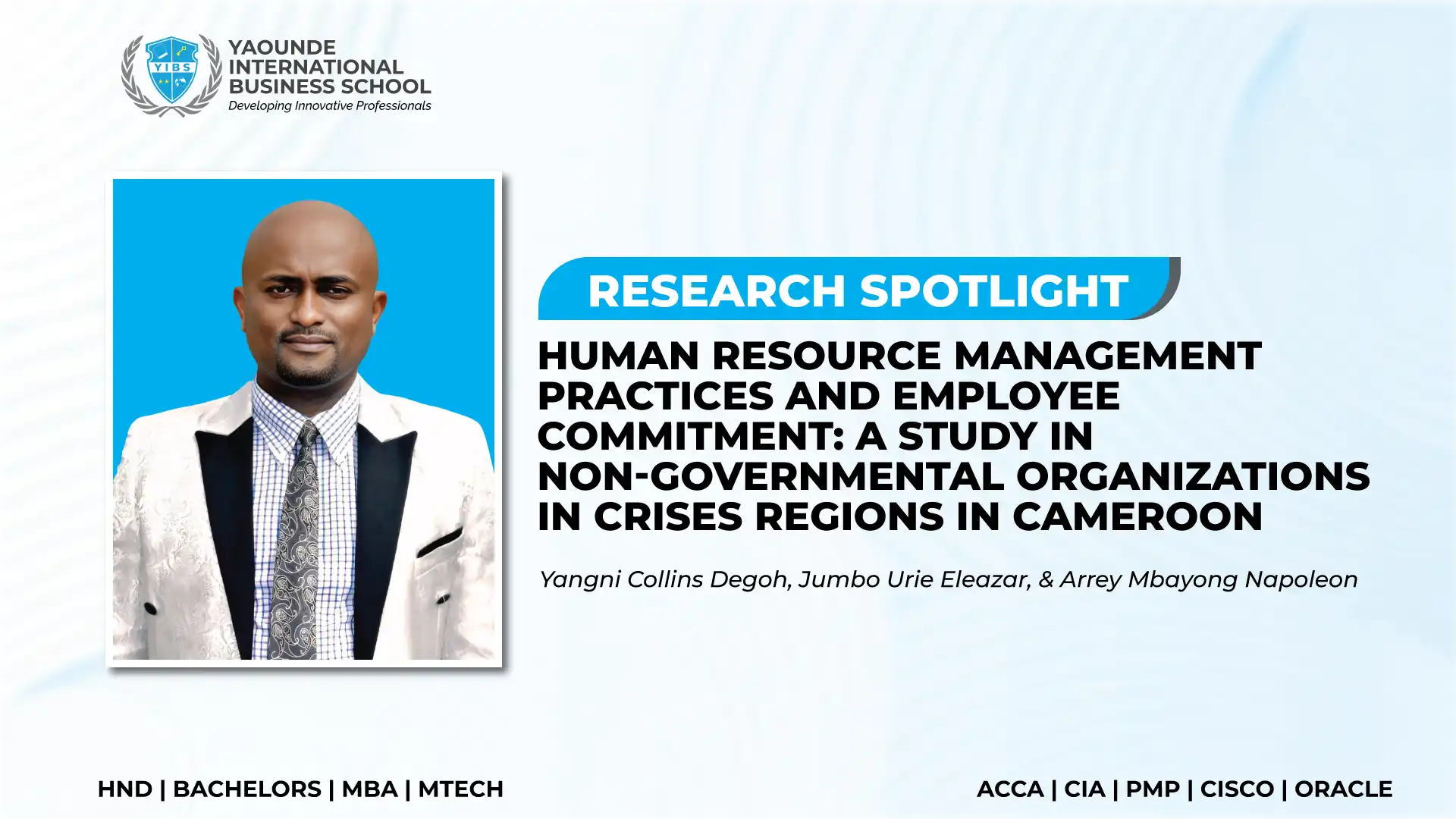
Yangni Collins Degoh, Jumbo Urie Eleazar, & Arrey Mbayong Napoleon
Department of Management and Marketing, Faculty of Economics and Management Sciences, the University of Bamenda, Cameroon
Higher Institute of Commerce and Management (HICM), the University of Bamenda, Cameroon
Corresponding Author: yangincollins@gmail.com
Abstract
Purpose: This study examined the relationship between Human Resource Management Practices (HRMP)
and employee commitment in Non-Governmental Organizations (NGOs) operating in crisis-affected
regions of Cameroon. The study aimed to investigate how HRMP dimensions, specifically effective
communication, justice and fairness practices, employee involvement and participation, and job security,
affect the commitment of employees working in fragile humanitarian settings, encompassing affective,
normative, and continuance commitment.
Methods: A quantitative approach was employed, using a cross-sectional, correlational research design.
Data were collected at a single point in time from staff across 110 NGOs in the South West, North West,
and Far North Regions, selected purposively to ensure representation of organizations actively engaged in
humanitarian response. Seemingly Unrelated Regression (SUR) and multivariate ordinary least squares
(OLS) were used to estimate the effects of HRMP dimensions on employee commitment.
Results: The findings revealed that effective communication had a significant and positive influence on
overall, affective, and normative commitment, while exhibiting a negative relationship with continuance
commitment. Similarly, job security was positively and significantly associated with overall, affective, and
normative commitment, but negatively associated with continuance commitment.
Implications: The study offers actionable insights for NGO managers, policymakers, and donors operating
in fragile and conflict-affected contexts by promoting the institutionalization of transparent communication
systems and ensuring job security.
Originality: This research contributes to the limited empirical literature on HRMP and employee
commitment in crisis-affected environments, particularly within Cameroon’s NGO sector.
Limitations: The study relied on self-reported data collected at a single point in time, which may introduce
response bias and limit causal inference. Additionally, the focus on NGOs in three regions of Cameroon
limits the generalizability of the findings to other contexts or sectors.